
Veneers or Braces? How to Tell Which One Your Case Needs, and Which Comes First
Veneers or braces is the question almost every smile consultation starts with. The two get compared as if they were rival products, but they do entirely different jobs.
One moves teeth. The other changes the surface of teeth that stay where they are.
Once you see that difference clearly, the choice usually makes itself. This guide covers what each treatment does, the four measurements that decide between them, and what to do when the honest answer is both.
Veneers or Braces: What Each One Actually Moves
Braces and aligners move roots. Over months, bone remodels around each tooth and the whole unit shifts to a new position.
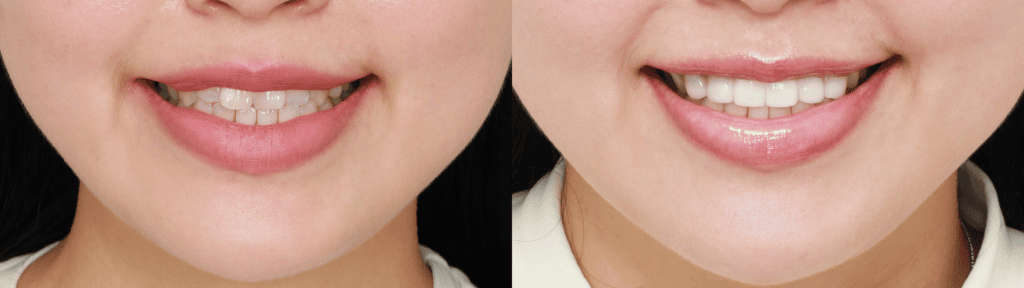
Porcelain veneers do not move anything. A thin shell is bonded to the front of the tooth, changing its shape, width, colour and edge position.
Think of a door that hangs crooked in its frame. Braces straighten the frame. Veneers refinish the door.
If the frame is only slightly off, refinishing the door hides it well. If the frame is badly twisted, no amount of refinishing will make the door sit straight.
That is the entire decision in one sentence. The rest is measurement.
Four Measurements That Decide Between Veneers or Braces
At a consultation we look at four numbers. Together they tell us whether porcelain can do the job on its own.
1. How deeply the teeth overlap
Mild rotation or crowding of about one millimetre can usually be absorbed into the veneer design. The shell is slightly thicker on one side and thinner on the other.
Beyond roughly two millimetres, that compensation starts to cost tooth structure. To get a flat front surface, more enamel has to come off the tooth that sits forward.
2. The angle of the root
This is the measurement patients rarely hear about, and it matters most. A tooth can look crooked because the crown is rotated, or because the whole root is tipped.
A rotated crown is a surface problem. A tipped root is a position problem, and porcelain cannot reach it.
3. Where your teeth actually touch
We check how the upper and lower front teeth meet, and where they contact during side-to-side movement. Veneers sit exactly in that path.
If the bite loads the front teeth edge to edge, the design has to account for it. If the lower teeth strike in front of the uppers, alignment normally comes first.
4. How much enamel is available
Bonding to enamel is far more reliable than bonding to the dentine underneath. So the plan is always shaped around keeping enamel, not around finishing fast.
When straightening a tooth first means removing less of it later, that is the better plan for the tooth. Our full explanation of preparation limits is in our guide to no-prep veneers in Korea.
Veneers or Braces: Which Case Goes Which Way
| What you see | What is really happening | Usual answer |
|---|---|---|
| One tooth slightly rotated | Crown rotation, root upright | Veneers |
| Small gaps between front teeth | Width shortfall, roots upright | Veneers |
| Teeth worn short and uneven | Shape loss, position fine | Veneers |
| Front teeth visibly stacked over each other | Crowding with tipped roots | Braces or aligners, veneers optional after |
| Upper teeth sit behind the lower ones | Skeletal or root position | Orthodontics first |
| Straight teeth, wrong colour or shape | Surface only | Veneers |
In practice, most people arrive somewhere between two rows. That is normal, and it is why the sequencing question below matters so much.
Veneers or Braces First? The Order Matters

When a case needs both, alignment comes first in almost every situation. The reason is simple arithmetic.
Teeth that are already in the right position need thinner porcelain. Thinner porcelain means less enamel removed, and a result that does not look bulky from the side.
Doing it the other way round creates a problem you cannot undo. Once a tooth has been prepared, moving it later means the bonded shell travels with it, and margins placed against healthy enamel end up in the wrong place.
The retainer question nobody asks early enough
Teeth drift back toward their old position after orthodontics. That is not a failure of treatment, it is biology.
So there is a waiting period before the final impressions are taken. There is also a retainer plan afterwards that has to work around the new veneer edges.
Ask about both at the orthodontic consultation, not after. If you are weighing aligners for that first phase, our Invisalign in Korea guide covers timelines and cost.
For combining several treatments into one plan, see our guide to a smile makeover in Korea.
Choosing Veneers or Braces When You Are Travelling

Orthodontics needs many short visits over many months. Veneers need a short, concentrated block of time.
That difference shapes what an overseas patient can realistically do. Alignment usually has to happen at home, with veneers finished on a single trip afterwards.
Send clear photos before you book. A front view, a side view and a photo of your bite let us tell you whether yours is a veneer case at all.
Blanche is near Nonhyeon Station in Gangnam, with our own in-house laboratory. Because design, fabrication and fitting happen under one roof, the veneer phase is completed within a single day.
That same-day format is priced higher than a conventional multi-visit approach. The director and the in-house lab team commit to one case for the whole day, and the price reflects that. Our pricing is identical for Korean and international patients.
For the full one-day programme, including technology, pricing and booking, see our One-Day Veneers page.
Veneers or Braces: What Actually Changes the Price
Ceramic grade is only part of it. The bonding system matters just as much, and it is rarely on a quote.
We use the Ivoclar adhesive system. It sits at the top of the price range for bonding materials, and it is chosen for biocompatibility and for colour stability at the margin, where discolouration would otherwise show first.
Frequently Asked Questions
Can veneers fix crooked teeth without braces?
Mild rotation and small gaps, yes. Crowding with tipped roots, no. The dividing line is whether the root is in the right place, which is why an X-ray is part of the answer.
Can I get veneers immediately after braces come off?
Not immediately. Teeth need a settling period in retainers first, otherwise the porcelain is fitted to a position that is still changing.
Are veneers cheaper than braces?
They are usually a shorter commitment, not a smaller one. They also need replacing eventually, while orthodontic movement is permanent.
Comparing them on price alone hides that difference. Our veneers versus crowns guide explains how we frame these comparisons.
Side Effects and Individual Variation
This article describes general diagnostic criteria. Outcomes vary with enamel thickness, gum condition, bite pattern and habits such as clenching.
Temporary sensitivity and gum irritation can occur after either treatment, and recovery differs between individuals. Any real decision needs an in-person examination with radiographs.
A Closing Note
After ten years of front-tooth work, the case I remember most clearly is not a difficult one. It is the patient who arrived certain that veneers were the answer, and left with a referral for six months of aligners instead.
She came back a year later. The porcelain we placed was thinner than what we would have needed on day one.
Less of her own tooth was removed, and the result sat flatter against her lip. Choosing between veneers or braces is really about choosing how much of your own tooth you keep.
If you would like to know which side your case falls on, send us photos and we will tell you honestly.
Dr. Kim Tae-hyung, Director, Blanche Dental Clinic
Consultation — Blanche Dental is located between Nonhyeon and Sinnonhyeon stations in Gangnam, Seoul. For a consultation in English, message us on WhatsApp with your photos, and see our pricing page for current fees.