
Temporary Veneers: What They Do, and When You Never Need Them
Almost every veneer guide online mentions temporary veneers in passing, then moves on. Patients are left with a stage they did not plan for and cannot picture.
That gap matters more if you are flying in for treatment. A temporary stage changes how many days you need, what you can eat, and how you will photograph in the meantime.
This article explains what temporary veneers are for, how to live with them if you have them, and why the stage disappears in some workflows.
What temporary veneers actually are
Temporary veneers are thin provisional shells, usually made of acrylic or composite. Your dentist places them on prepared teeth and holds them with a weak cement meant to release later.
They are not a lighter version of the finished restoration. They are a placeholder.
Their job is narrow. Cover exposed tooth surface, keep the gum from creeping into the space, and give you something to smile with while the real veneers are being made.
They also serve as a rough preview. The shape is approximate, and the colour rarely matches what you will end up with.
Why the temporary stage exists at all

The reason is logistics, not biology. Most clinics do not make veneers on site.
An impression or scan is sent to an outside dental laboratory. The lab queues the case, mills and layers the ceramic, then ships it back. That round trip is commonly one to three weeks.
Your teeth cannot sit prepared and uncovered for that long. So the clinic fills the gap with provisionals.
Once you see it that way, the logic is simple. The temporary stage is a symptom of the turnaround time, and it shrinks when that turnaround shrinks.
Temporary veneers compared with the finished ones
The differences are easy to underestimate until you are wearing them. This table sets out what changes.
| Feature | Temporary veneers | Final veneers |
|---|---|---|
| Material | Acrylic or composite | Layered or pressed ceramic |
| Bonding | Weak cement, meant to release | Full adhesive bond to enamel |
| Colour stability | Picks up stain within days | Highly resistant to staining |
| Surface | Slightly rough, plaque collects faster | Glazed and smooth |
| Fit at the gum line | Approximate | Shaped to the finished margin |
| Expected lifespan | Days to a few weeks | Years, with care |
Living with temporaries, if you have them
The weak cement is deliberate. It has to release cleanly at the next visit, so it will not survive the habits your final veneers can handle.
Bite with your back teeth and leave the front ones out of the work. Apples, crusty bread and anything you tear rather than chew are the usual culprits.
Floss carefully. Pull the floss out sideways rather than up, so you do not lift the provisional off the tooth.
Expect staining. Coffee, tea, red wine and turmeric all reach acrylic quickly, and polishing does not fully reverse it.
If one comes off, keep it and call the clinic. An uncovered prepared tooth is sensitive, and the neighbouring teeth can drift within days.
When you never need temporary veneers
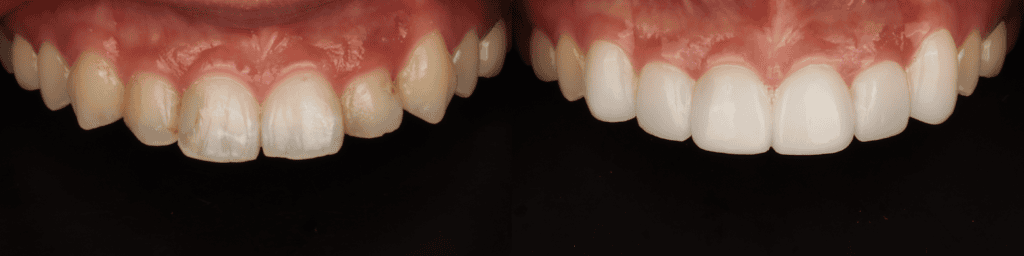
If the ceramic is made in the same building on the same day, there is no waiting period to bridge. The provisional stage simply never begins.
That is how our workflow runs. Blanche keeps its own laboratory, Blanche Lab, inside the clinic near Nonhyeon Station.
Diagnosis, design, fabrication and adjustment happen in one day, with the dentist and the in-house technicians working on your case together. More involved cases are given more design and adjustment time within that same day, rather than being pushed into another visit.
Removing the temporary stage removes its problems with it. No provisional staining before an event, no loose shell on a flight home, no second trip to Seoul.
It also changes the pricing conversation. Same-day treatment is priced higher than the staged approach, because compressing everything into one day concentrates the dentist and the lab team time on your case alone.
For the full one-day programme — technology, pricing, and booking — see our One-Day Veneers page.
A rental car is not a preview of the car you ordered
When your car is in the shop, the loaner gets you to work. Nobody judges the car they ordered by how the loaner drives.
Temporaries work the same way. Patients sometimes panic at the shade or the bulk of a provisional, and that reaction is understandable but misplaced.
The useful thing to check is length and edge position, not colour or surface. Those are the notes worth passing back before the final ceramic is finished.
What to ask before you agree to a staged plan

If you are travelling for treatment, four questions decide your itinerary.
First, is the laboratory in-house or external? Second, how many days between preparation and fitting?
Third, will you be wearing provisionals during that gap, and who adjusts them if one loosens after you leave? Fourth, is the fitting visit included in the quoted fee, or billed separately?
Our fees are the same for international and Korean patients, and photo consultation before you fly lets us answer the timing questions before you book anything. The wider visit sequence is set out in our guide to getting veneers in Korea.
What we see in practice
Patients who arrive from abroad already wearing provisionals from a clinic at home are a familiar group. The prepared teeth underneath are usually fine, but the provisionals have picked up stain and the gum line is inflamed from the rougher surface.
Another recurring situation is a provisional that has been worn far past its intended span. The margin leaks, and the tooth beneath needs cleaning before anything is bonded.
Adhesive quality matters at that final step. We use the Ivoclar bonding system, which sits at the higher end of the market but offers biocompatibility and colour stability at the margin, where a weak bond shows first. If you are replacing older work, the sequence is covered in our article on veneer replacement in Korea.
Outcomes differ from person to person. Gum condition, bite force and how much enamel remains all change what is possible.
Frequently asked questions
How long can temporary veneers stay on?
They are designed for days to a few weeks. Worn longer, the weak cement washes out at the margin and the tooth underneath becomes vulnerable. If your final restorations are delayed, ask to have the provisionals recemented rather than leaving them.
Do temporary veneers look like the final result?
Only roughly. Length and edge position are worth reviewing at that stage, because they can still be changed. Colour, translucency and surface texture come from the ceramic and the bonding layer, so a provisional cannot show them.
Can I fly home wearing temporaries?
You can, but it means returning for the fitting. Ask before booking whether the clinic makes the ceramic in-house, since a same-day workflow lets you finish in one trip and skip the provisional stage altogether.
Side effects and individual variation
Every dental treatment carries individual variation. Prepared teeth can be temporarily sensitive, and gum tissue often needs a settling period.
A strong bite or a grinding habit raises the chance of chipping or debonding. The amount of remaining enamel and the condition of your gums both change what is realistic.
This article is general information. Your own plan is decided after an examination.
I am Dr. Kim Tae-hyung, director of Blanche Dental Clinic. When patients ask me about the temporary stage, my honest answer is that it is a workaround for a scheduling problem rather than a clinical step worth wanting.
Building the laboratory inside the clinic was how we removed it. The technicians and I look at the same case in the same room on the same day.
If you are weighing up a trip and want to know how many days you would actually need, send us a photo and we will talk it through before you book.
Consultation — Blanche Dental is located between Nonhyeon and Sinnonhyeon stations in Gangnam, Seoul. For a consultation in English, message us on WhatsApp with your photos, and see our pricing page for current fees.