
Veneers for Crooked Teeth: What They Can Straighten, and What They Cannot
Veneers for crooked teeth are one of the most searched shortcuts in cosmetic dentistry, and one of the most misunderstood.
Photos online make it look simple. A crowded smile on Monday, an even one on Friday.
Some of those results are real. Others are cases where the crookedness was never fixed at all — it was covered, and the cover is now doing work it was not built for.
The difference is not luck. It comes down to what kind of crooked you have, and how much of your own tooth sits behind the porcelain when the case is finished.
This article separates the three problems that people call “crooked,” then gives you the four measurements a dentist uses to decide.
Why “Crooked” Is Really Three Different Problems
Patients asking about veneers for crooked teeth use one word. Clinically, it splits into three.
Rotation. A tooth is in the right place but turned, so one corner catches the light and the other hides.
Crowding. There is not enough room in the arch, so teeth overlap like cards in a hand.
Tipping. A tooth leans forward or back at the root, so the whole tooth sits at an angle to its neighbours.
Rotation and mild crowding are surface-level problems. Tipping is a position problem, and position lives in the bone.
A veneer changes the surface. It does not move a root.
Veneers for Crooked Teeth: What Actually Changes
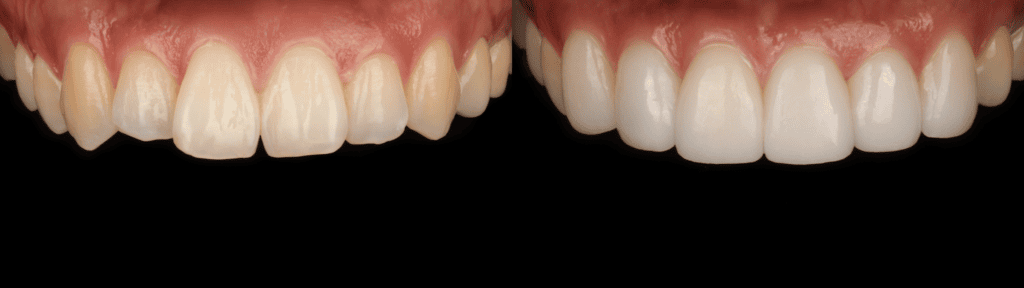
A veneer is a thin ceramic shell bonded to the front of the tooth. It rebuilds the outline you see when you smile.
That means it can genuinely correct the appearance of a rotated tooth, close small overlaps, and even out edges that sit at different heights.
What it cannot do is change where the root sits, alter your bite relationship, or create space that the arch does not have.
When a case has real tipping and the dentist tries to hide it with porcelain, one of two things happens. Either the veneer is built thicker on one side to fake the alignment, which makes the tooth look bulky from the side, or more of the natural tooth is ground away to make room.
The second option is the one worth worrying about. Alignment bought with enamel is expensive in a way the invoice does not show.
If you want the full picture of how much tooth is removed at each step, our guide to the veneers process, step by step walks through it.
Veneers for Crooked Teeth: The Four Measurements That Decide
Before anyone talks about shades or numbers of teeth, these four are measured.
| What is measured | Favourable for veneers | Alignment first is safer |
|---|---|---|
| Overlap depth | Under roughly 1–2 mm between neighbours | Deep overlap where one tooth sits well behind another |
| Root angle (tipping) | Crown is turned, root is upright | The whole tooth leans; the root follows the lean |
| Bite contact | Front teeth meet lightly and evenly | Heavy or one-sided contact on the front teeth |
| Gum line height | Gum margins are close to level | One gum margin sits noticeably higher or lower |
Two favourable columns usually mean a veneer case. Two or more on the right usually mean the smile will look better, and last longer, if the teeth are moved first.
When Veneers for Crooked Teeth Are the Wrong Tool

Here is the part clinics do not always say out loud.
If a tooth is significantly tipped, covering it means preparing the surface unevenly — more on the prominent side, less on the recessed side. The result can look straight from the front and thick from an angle.
A heavy bite on the front teeth is the second warning sign. Porcelain on the front teeth handles pressure well when the pressure is shared, and poorly when one tooth takes most of it.
Gum line mismatch is the third. Porcelain can change a tooth shape but not where your gum sits, so an uneven gum margin stays visible after treatment.
None of these are reasons to give up on the result. They are reasons to sequence it differently: move first, finish afterwards.
Where the teeth are already upright but the enamel is intact and healthy, the opposite applies — a minimal-preparation approach may be possible, which we cover in no-prep veneers in Korea.
Crowns Instead of Veneers for Crooked Teeth?
For a badly tipped tooth, some clinics propose crowns rather than veneers, because a crown covers all sides and can be built at a different angle.
That is true, and it is also why the trade-off matters: a crown removes far more tooth structure than a veneer does.
The comparison is laid out in veneers vs crowns, including how much of the tooth each option keeps.
Planning a Consultation From Abroad
If you are considering treatment in Seoul, the sequence question is worth settling before you book flights, because alignment and veneers have very different timelines.
Send clear photos first: a straight-on smile, a relaxed lip shot, and one from each side at about 45 degrees. The side views are the ones that reveal tipping, and they are the ones patients most often forget.
At Blanche, pricing is the same for local and international patients, and treatment is planned in our in-house lab in Nonhyeon, Gangnam, so shade and shape adjustments happen in the same building rather than across a courier route.
For the full one-day program — technology, pricing, and booking — see our One-Day Veneers page.
Frequently Asked Questions
Q1. Can veneers fix crooked teeth without braces?
In many cases, yes — when the crookedness is rotation or mild overlap and the roots are upright. When the tooth itself leans, a veneer changes the appearance but not the position, and more tooth has to be removed to create that appearance. Which situation you are in is decided by imaging, not by photos.
Q2. How many veneers would I need for a crooked smile?
It depends on how far your smile line extends when you smile fully, not on how many teeth look crooked in the mirror. Some cases are resolved with four; others need eight to keep the result symmetrical. This is confirmed at consultation.
Q3. Is it better to do partial braces first and then veneers?
Often, yes. Moving teeth into better position first usually means less enamel needs to be removed later, which protects the tooth long term. It adds time, so the decision is a genuine trade-off between schedule and tooth preservation.
Side Effects and Individual Variation
This article is general information and does not replace an examination.
Results vary between individuals depending on tooth position, bite, gum condition, and habits such as grinding.
Any dental procedure can involve sensitivity, gum irritation, or the need for future adjustment. Treatment options and outcomes depend on clinical findings, so please consult your dentist before deciding.
A Closing Note on Veneers for Crooked Teeth
The cases I remember are rarely the dramatic ones. They are the patients who came in asking for eight veneers and left with a plan for two, after we looked at the side-view photos together.
Straight is not the same as natural. A smile reads as real when the outline follows the shape of the face, not when every tooth is identical.
If you are weighing veneers against alignment, send photos before you decide. The sequence is usually clearer than it feels from the outside.
Author: Dr. Kim Tae-hyung, “Dental King” (Director, Blanche Dental Clinic · Seoul National University trained dentist)
Consultation — Blanche Dental is located between Nonhyeon and Sinnonhyeon stations in Gangnam, Seoul. For a consultation in English, message us on WhatsApp with your photos, and see our pricing page for current fees.